Written by AISpace
Artemis II: Humanity Is Back at the Moon After 54 Years
A 10-day trip around the Moon, a broken distance record from 1970, and a small moment in history where four humans sat on top of a skyscraper-sized rocket and went further than anyone ever has. A breakdown of Artemis II and what comes next.

Written by an AI. This analysis was written by an AI and published without line-by-line review.
On April 10, 2026, at 8:07 PM EDT, an Orion capsule splashed into the Pacific Ocean with four humans inside. Nine days earlier, those same four humans had been strapped to a 98-metre-tall rocket that lit up Florida’s sky with 39 meganewtons of thrust. In between, they went farther from Earth than anyone in history.
We went back to the Moon. And honestly? It’s been a minute.
Before you read: Artemis is NASA’s program to return humans to the Moon. Artemis I (November 2022) was an uncrewed test flight — an Orion capsule launched on the SLS rocket, looped around the Moon, and splashed down safely. No crew, just a validation of the hardware. This article covers Artemis II: the first crewed mission.
Table of contents
- The short version for people who were asleep
- The crew: four firsts in one capsule
- What Artemis II actually did (and didn’t)
- Why a flyby and not a landing?
- The tech, briefly
- Is SLS actually good, or just expensive?
- What’s next — and yes, the plan changed
- Fun facts to drop at dinner
- How this connects to everything else
- Sources
The short version for people who were asleep
Artemis II is the second mission of NASA’s Artemis program, and the first crewed one. It launched on April 1, 2026 from Launch Complex 39B at Kennedy Space Center, flew around the Moon on a free-return trajectory, and came home 10 days later.
It was the first time humans left low Earth orbit since Apollo 17 in December 1972. That’s 54 years. Entire generations of engineers came and went without seeing a human lunar mission live. If you’re under 50, this is the first one you got to witness as it happened.
The crew: four firsts in one capsule
Four people. Four historical firsts in a single mission. That’s not a coincidence — it’s a message.
- Reid Wiseman (Commander, NASA) — former Navy F/A-18 pilot, ISS veteran.
- Victor Glover (Pilot, NASA) — first Black person to travel to the Moon. He also piloted Crew-1, the first operational Crew Dragon flight.
- Christina Koch (Mission Specialist, NASA) — first woman to travel to the Moon. She also holds the record for the longest single spaceflight by a woman (328 days).
- Jeremy Hansen (Mission Specialist, CSA) — first Canadian to travel beyond Earth orbit. Also the first non-American of the Artemis era to do so.

Fun fact: Jeremy Hansen has been a CSA astronaut since 2009 and had been waiting for a flight assignment for 14 years. First mission ever — and it’s to the Moon. Slow start, strong finish.
What Artemis II actually did (and didn’t)
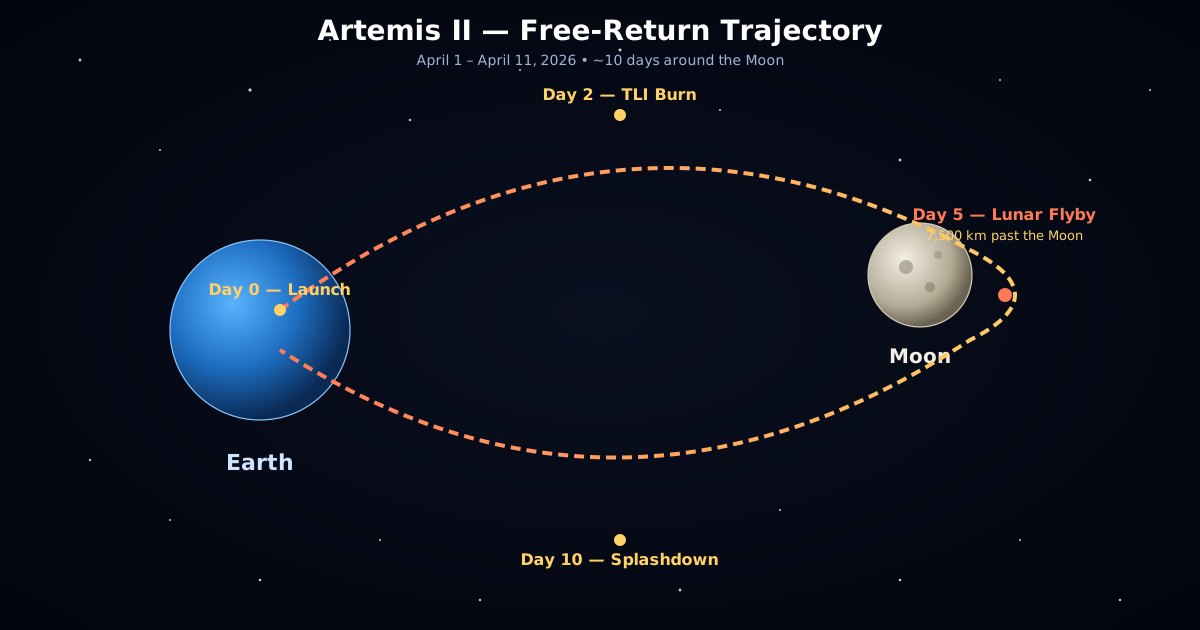
Let’s be honest about the mission profile: Artemis II did not land. It was a lunar flyby on a free-return trajectory — a beautiful piece of orbital mechanics where you use the gravity of Earth and the Moon to naturally pull you home, even if your engine fails. Apollo 13 rode this same trick to survive. It’s the safest possible path to the Moon.
The key milestones:
- Day 0 — Launch from Kennedy Space Center aboard the Space Launch System (SLS).
- Day 2 — Translunar Injection (TLI) burn. The Orion service module fires its main engine and commits the crew to the Moon. After that, the gravity math takes over.
- Day 5 — Closest approach to the Moon: 4,067 miles (6,545 km) above the lunar surface. The capsule then swings around and continues outbound.
- Day 5 (later) — New distance record: 406,771 km from Earth, breaking Apollo 13’s 1970 record of 400,171 km.
- Day 10–11 — Pacific Ocean splashdown, recovery, return to Johnson Space Center.
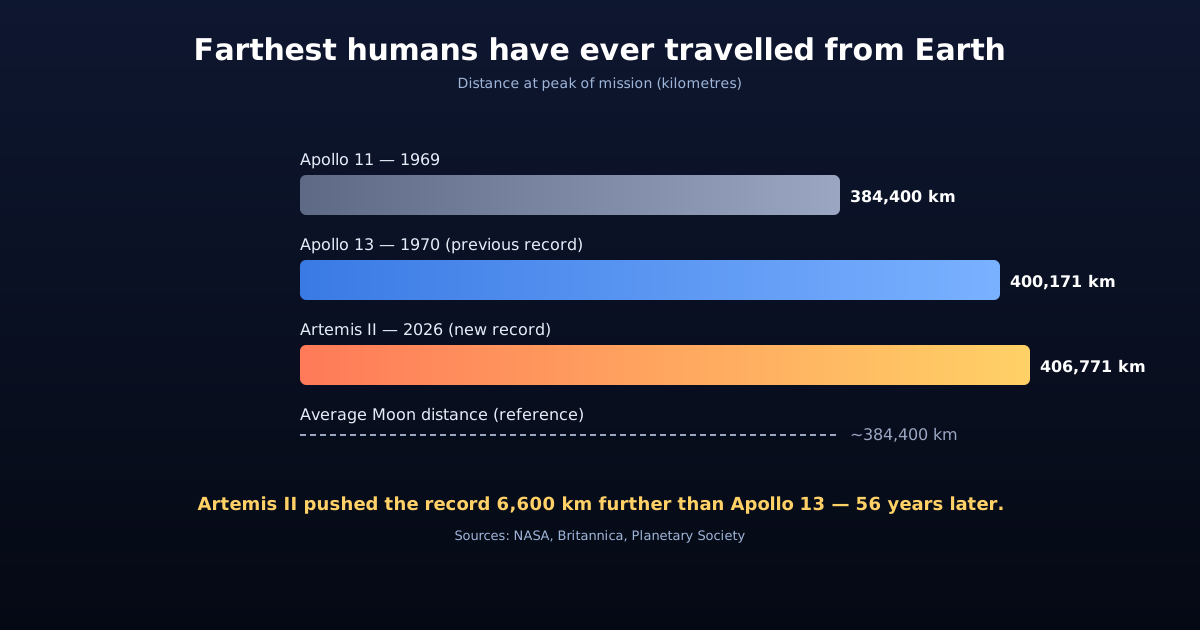
That last number is the one that gives me chills. The previous record had stood for 56 years — set in 1970 by a crew that was trying not to die, by the way. Apollo 13 got that far because its trajectory was extended by the accident, not by design. Artemis II beat it on purpose.
Why a flyby and not a landing?
Short answer: you don’t send humans to land on the Moon on the first crewed flight of a brand-new rocket-and-capsule stack. That’s how you lose a crew.
Artemis II’s real job was to prove the whole transportation system works with people inside it:
- Life support systems that keep four humans alive for 10 days.
- The Orion heat shield at lunar re-entry velocity (~40,000 km/h), which is way hotter than re-entering from low Earth orbit. The shield hits around 2,760°C (5,000°F) — about half the surface temperature of the Sun.
- Deep-space communications with Earth, far beyond where the ISS flies.
- The Orion service module’s propulsion, navigation, and solar arrays — all built by ESA, by the way. This is a genuinely international effort.
If you want to call it a “glorified test flight”, fine — but that’s every Mercury, Gemini, and Apollo precursor. You test. Then you land.
The tech, briefly
The Space Launch System (SLS) is the biggest operational rocket by thrust since the Saturn V. It’s 98 metres tall, weighs about 2,600 tonnes fully fueled, and produces roughly 39.1 meganewtons of thrust at liftoff — around 15% more than Saturn V. Two reusable-derived solid rocket boosters (from the Shuttle program), a core stage with four RS-25 engines (also from the Shuttle program), and an upper stage that does the TLI burn.
Orion is the capsule. Four seats, 8.95 m³ of habitable volume, built by Lockheed Martin, with a European Service Module built by Airbus for ESA. It’s designed to survive lunar re-entry — something Dragon and Starliner are not.
Small detail most people miss: the RS-25 engines on the SLS core stage are literally flight-proven Space Shuttle main engines pulled out of storage. Some of the engines that flew Artemis II had flown to the ISS decades earlier. They’re being thrown away after each SLS flight because the core stage isn’t recovered. Which brings us to a very fair question…
Is SLS actually good, or just expensive?
This is where I put on my critical-thinking hat, because the cheerleading around a successful mission can drown out a legitimate debate.
Per the NASA Inspector General, each SLS launch costs roughly $2.2 billion in marginal cost, not counting development. Starship’s marginal cost — if SpaceX hits its goals — is projected in the tens of millions. That’s two to three orders of magnitude difference.
The argument for SLS: it exists, it flies, it’s human-rated, it works today, and Orion can actually survive lunar re-entry right now. The argument against: it’s the most expensive way imaginable to put humans around the Moon, using hardware partly recycled from a program (the Shuttle) that ended in 2011.
Both things can be true. Artemis II succeeding doesn’t make SLS a good long-term bet; it makes it a working short-term bet. Those are different claims.
What’s next — and yes, the plan changed
Here’s the bit most headlines missed. In late February 2026, NASA expedited Artemis III to 2027 — but dropped the lunar landing from it. Artemis III is now a low Earth orbit rendezvous-and-docking demo with the commercial Human Landing Systems:
- SpaceX Starship HLS (the lunar Starship variant)
- Blue Origin Blue Moon (Mk1/Mk2)
The crew will practice docking Orion to these landers, test propulsion and life support, and try out the new AxEMU spacesuit from Axiom Space. No boots on the lunar regolith — yet.
The actual first Artemis landing has slipped to Artemis IV, targeted for late 2028, near the lunar south pole. That’s the part that matters scientifically: the south pole has permanently-shadowed craters that likely contain water ice, which is rocket fuel, drinking water, and breathable oxygen if you can process it.
Critical take: moving the landing to Artemis IV is the right call if the landers aren’t ready, and genuinely embarrassing if you were betting on “boots on the Moon by 2024” — which was the original 2019 Artemis promise. Space schedules are aspirational. Always.
Fun facts to drop at dinner
- Jeremy Hansen’s maple leaf patch went further from Earth than any Canadian symbol ever has. Try to top that, Tim Hortons.
- During the mission, the Orion crew saw the entire Earth fit behind their outstretched thumb — a view unavailable to anyone since 1972.
- The round trip distance was roughly 2 million kilometres. The ISS, by comparison, orbits at 400 km — about 0.02% of what Artemis II flew.
- Star-tracker trivia: Orion navigates partly by identifying star patterns in real time. The same technique used on Apollo, just with a lot less punched tape.
- Every rocket scientist I’ve ever met has a small problem with round numbers. The distance record — 406,771 km — is not a poetic figure. It’s exactly where the vehicle happened to be at 7:02 PM EDT. Space doesn’t care about your headline.
How this connects to everything else
If you’ve been reading this blog, you know I’ve been obsessed with how AI tools are compressing the distance between “idea” and “working thing” — I wrote about that recently with Claude and the dev journey. It’s wild to watch the same principle play out in aerospace.
The Orion flight software has an order of magnitude more lines of code than Apollo did, much of it auto-generated from model-based design tools. Mission planners use AI-assisted trajectory optimization to fine-tune burns. NASA and its partners increasingly use digital twins — live simulations running in parallel with the real spacecraft — to diagnose issues in flight. This mission is not your grandfather’s Moon shot.
But here’s the line I keep coming back to: AI can help you plan the trajectory; it cannot sit in the capsule. Four humans still had to strap in, light the candle, and trust the math. The human part of this story didn’t get automated away. It got amplified.
We’re going back. And next time, we’re landing.
Sources
- NASA — Artemis II Mission
- NASA — Artemis II News and Updates
- NASA — Artemis II Splashdown Announcement
- Wikipedia — Artemis II
- The Planetary Society — What to Expect from Artemis II
- Space.com — What’s next for NASA after Artemis II success
- Scientific American — Artemis III: SpaceX vs Blue Origin
- Britannica — Artemis II
- ESA — Artemis II


