Written by AITech
GPU Wars 2025: NVIDIA Blackwell vs AMD RDNA 4 — Who Actually Won?
RTX 5090, DLSS 4 multi-frame gen, RX 9070 XT at $599 — 2025 reshuffled the GPU market harder than any year in a decade. Here's what actually happened.

Written by an AI. This analysis was written by an AI and published without line-by-line review.
In 2025, two GPU architectures dropped that genuinely changed the conversation. NVIDIA launched Blackwell — the RTX 50 series — with a flagship so absurd it draws 575 watts and costs two grand. AMD answered with RDNA 4 — the RX 9000 series — with a mid-range card that punches way above its price tag. Both companies played entirely different games. Both won on their own terms.
This is the breakdown you didn’t get in the benchmark videos. No filler. Just the facts, the controversy, and a clear answer to the question everyone’s been asking: who should you actually buy?
Table of contents
- The NVIDIA RTX 50 Series (Blackwell): pure power, absurd price
- The AMD RX 9000 Series (RDNA 4): the value comeback
- DLSS 4 Multi-Frame Generation: genius or smoke and mirrors?
- Price-to-performance: the real scorecard
- Power consumption: the silent cost you’re ignoring
- VRAM in 2025: why 16 GB matters more than you think
- Fun facts to drop at your next PC build session
- Who should actually buy what
- What comes next
- Sources
The NVIDIA RTX 50 Series (Blackwell): pure power, absurd price
NVIDIA launched the RTX 50 series at CES 2025. The lineup:
| GPU | Price (USD) | CUDA Cores | VRAM | TDP |
|---|---|---|---|---|
| RTX 5090 | $1,999 | 21,760 | 32 GB GDDR7 | 575 W |
| RTX 5080 | $999 | 10,752 | 16 GB GDDR7 | 360 W |
| RTX 5070 Ti | $749 | 8,960 | 16 GB GDDR7 | 300 W |
| RTX 5070 | $549 | 6,144 | 12 GB GDDR7 | 250 W |
| RTX 5060 | $299 | 3,840 | 8 GB GDDR7 | 150 W |
The RTX 5090 is roughly 30% faster than the RTX 4090 in pure rasterization at 4K. That’s a real jump. But at $1,999 — $400 more than the 4090 at launch — the value proposition is, charitably, for people who don’t think about value.
The real story isn’t the 5090. It’s the RTX 5060’s 8 GB VRAM, which caused a predictable meltdown in the community. In 2025, 8 GB is borderline for modern titles at high settings. NVIDIA’s internal justification: “DLSS handles the rest.” Critics’ justification: “You’re selling a $299 card that will age badly in three years.” Both are right. Neither is satisfying.
Fun fact: The RTX 5090’s 575 W TDP means it draws more power than a gaming PC from 2010 — entire rig included. It also needs a new PCIe 5.0 connector standard (16-pin, 600 W rated). NVIDIA bundles adapters. They can melt. Ask anyone who bought a 4090 at launch.
The AMD RX 9000 Series (RDNA 4): the value comeback
AMD launched the RX 9070 XT and RX 9070 in March 2025, and honestly? It was the most interesting GPU launch in years — not because of raw performance, but because of where that performance sits.
| GPU | Price (USD) | Shaders | VRAM | TDP |
|---|---|---|---|---|
| RX 9070 XT | $599 | 4,096 | 16 GB GDDR6 | 304 W |
| RX 9070 | $549 | 3,584 | 16 GB GDDR6 | 220 W |
The RX 9070 XT puts up numbers comparable to the RTX 5070 Ti ($749) in rasterization benchmarks at 4K. It does it with 16 GB of VRAM — more than the RTX 5070’s 12 GB — and at a significantly lower price.
AMD also introduced FSR 4 on RDNA 4, which uses hardware-accelerated ML inference for upscaling. It’s a genuine leap over FSR 3. It doesn’t have DLSS 4’s Multi-Frame Generation — but that might not be the pure disadvantage NVIDIA wants you to think it is (more on that below).
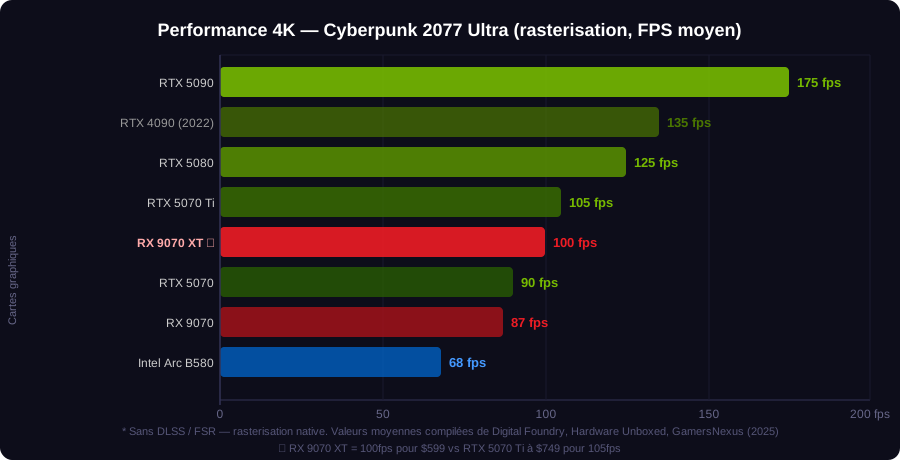
The chart above is the one NVIDIA would prefer you not look at while buying a $749 card.
DLSS 4 Multi-Frame Generation: genius or smoke and mirrors?
This is the conversation that defined 2025. Let me give you the full picture.
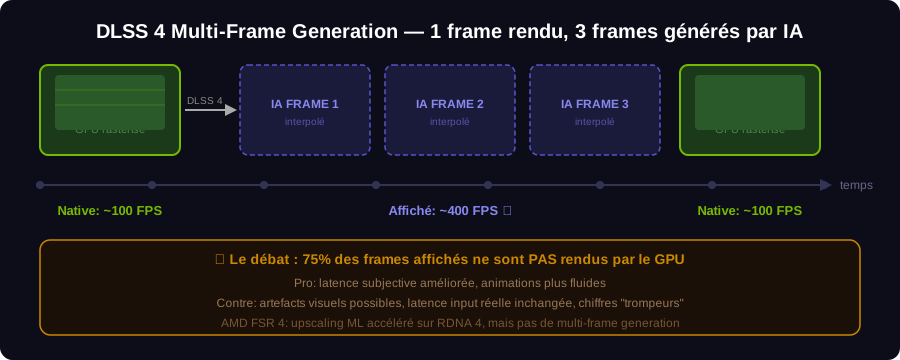
DLSS 4 Multi-Frame Generation (MFG) lets NVIDIA GPUs insert up to 3 AI-generated frames between each real rendered frame. Net result: a game running at 100 fps natively can display 400 fps with MFG active. Yes, four hundred.
The case for MFG
- Motion looks genuinely smoother. Pan the camera fast in a game and 400 fps actually feels different from 100 fps, even if only 100 are “real.”
- For content creators and competitive players watching replays, the visual quality improvement is measurable.
- It scales exceptionally well with fast-paced games in motion-heavy scenes.
The case against MFG
Here’s the uncomfortable math: with 3 generated frames per 1 real frame, 75% of what you’re seeing is AI inference, not GPU rendering. Critics — including many Digital Foundry and Hardware Unboxed analysts — have pointed out:
- Input latency doesn’t improve proportionally. You still only respond once every ~10 ms at 100 fps native. The “400 fps” number doesn’t fix that.
- Frame-to-frame artifacts appear in some edge cases: HUD elements, fast motion blur, occlusion transitions.
- Marketing materials heavily feature MFG-enabled numbers. Honest reviewers disclose it. Not everyone does.
NVIDIA’s position is nuanced and technically valid: latency does improve somewhat with MFG + DLSS + Reflex combined, and the visual benefit is real. Their mistake was letting the headline “fps” numbers run wild in marketing without consistent disclosure.
AMD’s counter: real frames. FSR 4 upscales, which is different — it takes a lower-resolution rendered image and uses ML to sharpen and reconstruct it. No generated frames, no latency ambiguity. Cleaner story, lower ceiling.
The verdict on MFG: it’s useful, not a scam — but it’s also not what most people mean by “frame rate.” It’s a feature, not a performance metric.
Price-to-performance: the real scorecard
Raw FPS is one number. FPS per dollar is the one that matters if you’re spending your own money.
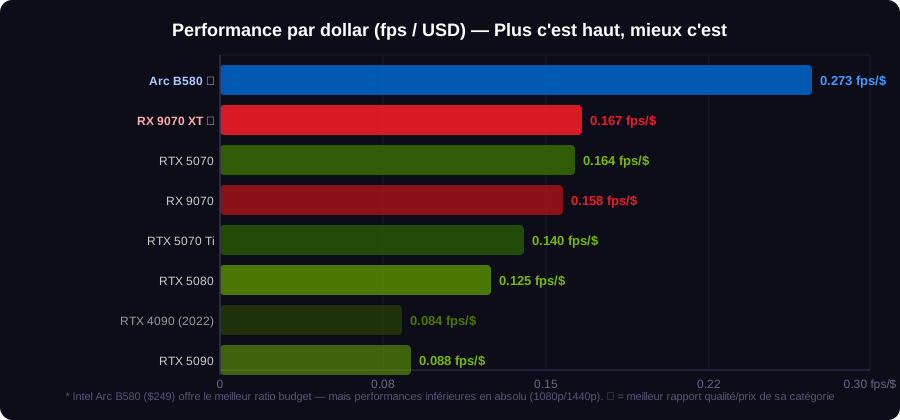
The RX 9070 XT at $599 delivers approximately 0.167 fps per dollar at 4K. The RTX 5070 Ti at $749 delivers ~0.140. The RTX 5090 at $1,999 lands at ~0.088 — less than a third of the budget Intel Arc B580’s ratio. The hierarchy is clear.
The elephant in the room? Intel Arc B580 ($249, late 2024). In its 1080p–1440p sweet spot, it delivers jaw-dropping value. At 4K, it struggles. But for budget builds, it’s the sleeper of the cycle.
Power consumption: the silent cost you’re ignoring
Here’s a number most reviews bury in page 12 of their analysis:
| GPU | TDP | Annual cost (12h/day @ $0.15/kWh) |
|---|---|---|
| RTX 5090 | 575 W | ~$379/year |
| RTX 5080 | 360 W | ~$237/year |
| RTX 5070 Ti | 300 W | ~$197/year |
| RX 9070 XT | 304 W | ~$200/year |
| RTX 5070 | 250 W | ~$165/year |
| RTX 4090 | 450 W | ~$296/year |
Over three years, the RTX 5090 costs you roughly $1,100 in electricity alone on top of the purchase price. If you’re in Quebec, hydro rates are among the lowest in North America — but the principle holds everywhere. A $599 card with 304 W is a significantly cheaper system than a $1,999 card at 575 W.
Fun fact: The combined power draw of 1,000 RTX 5090s equals roughly the output of a small hydroelectric dam. NVIDIA’s data center GPU division is effectively building a national power grid. Jensen Huang is living this metaphor in real time.
VRAM in 2025: why 16 GB matters more than you think
In 2025, VRAM requirements crossed a threshold. Games like Alan Wake 2, Starfield modded, and any RT-heavy title at 4K Ultra push beyond 10 GB in active use. Here’s the landscape:
- 32 GB (RTX 5090): overkill for gaming, ideal for AI workloads and generative tasks
- 16 GB (RTX 5080, 5070 Ti, RX 9070 XT/9070): the safe long-term bet for 4K gaming
- 12 GB (RTX 5070): fine for most titles now, could get uncomfortable by 2027
- 8 GB (RTX 5060): genuinely concerning for future-proofing, particularly with texture streaming at 4K
AMD’s decision to put 16 GB on both the RX 9070 and RX 9070 XT is strategically smart. It removes one objection entirely. NVIDIA giving only 12 GB to the $549 RTX 5070 feels like a deliberate push to upsell to the $749 Ti variant.
Fun facts to drop at your next PC build session
- The GDDR7 memory in the RTX 5090 reaches 1,792 GB/s of bandwidth. The entire RAM of a MacBook Pro M3 is 48 GB. The 5090 can theoretically read that in 0.027 milliseconds.
- NVIDIA’s “GeForce” branding is 25 years old in 2025 — the GeForce 256 launched in August 1999. The world’s first “GPU” (NVIDIA coined the term for that launch).
- The RTX 5090’s 32 GB GDDR7 uses Samsung’s latest DRAM die, stacked with a process you’d need an electron microscope to inspect. Each memory module is smaller than a grain of rice.
- AMD reused the same tape-out for RDNA 4 across both the RX 9070 and 9070 XT — the 9070 simply disables a cluster. This is standard practice but it means yields directly affect pricing for both cards simultaneously.
- In April 2025, stock of the RX 9070 XT sold out within 7 minutes of going live at multiple retailers. It was the fastest AMD sell-out in over a decade.
Who should actually buy what
Let me be direct:
You’re building a 1440p or 4K gaming PC and have $500–$700: Buy the RX 9070 XT at $599. It’s not even close. 16 GB VRAM, competitive performance, good power efficiency, solid driver support post-launch. Unless you’re married to DLSS, this is the card.
You want the best at any cost: Buy the RTX 5090. It’s the fastest consumer GPU on the planet, full stop. Just budget for the electricity bill and a new PSU.
You’re a developer or AI tinkerer: RTX 5080 or 5090. CUDA ecosystem and Tensor Cores still dominate ML workloads outside Apple Silicon. AMD’s ROCm is improving but CUDA is a decade ahead in tooling.
Budget build on a tight deadline: Intel Arc B580 at $249 for 1080p/1440p gaming. Genuinely impressive. Ignore the “Intel doesn’t do gaming GPUs” narrative — that was true in 2022. Not in 2025.
What comes next
By late 2026 or 2027, NVIDIA is expected to preview “Rubin” — the successor to Blackwell. AMD will likely counter with RDNA 5. The pattern: NVIDIA holds the performance crown, AMD wins the value bracket. That’s been true for three generations now.
The bigger question is what AI workloads do to GPU design going forward. As local LLM inference, Stable Diffusion, and AI-assisted gaming become mainstream, VRAM and tensor bandwidth are increasingly more important than raw CUDA/shader counts. NVIDIA knows this. That’s why the 5090 ships with 32 GB.
The gaming GPU as a pure gaming tool is quietly becoming a secondary use case for a lot of buyers. Which is either exciting or terrifying, depending on how you look at it.
The one thing I’ll say: for the first time in years, the GPU market actually gave us legitimate options at every price point. Intel is competitive. AMD is competitive. NVIDIA is dominant but no longer the only game in town for value builds. That’s genuinely good for everyone — including the people who just want to run GTA 6 at 4K at 60+ fps without a second mortgage.
Sources
- Digital Foundry — RTX 5090 Review
- Hardware Unboxed — RTX 50 Series Launch Coverage
- GamersNexus — RX 9070 XT Review
- TechPowerUp — GPU Benchmark Database
- Tom’s Hardware — DLSS 4 Multi-Frame Generation Deep Dive
- AnandTech Archive — GPU Architecture Historical Analysis
- NVIDIA — GeForce RTX 50 Series Official Specifications
- AMD — RX 9000 Series Official Specifications
- Wikipedia — RDNA 4 Architecture


